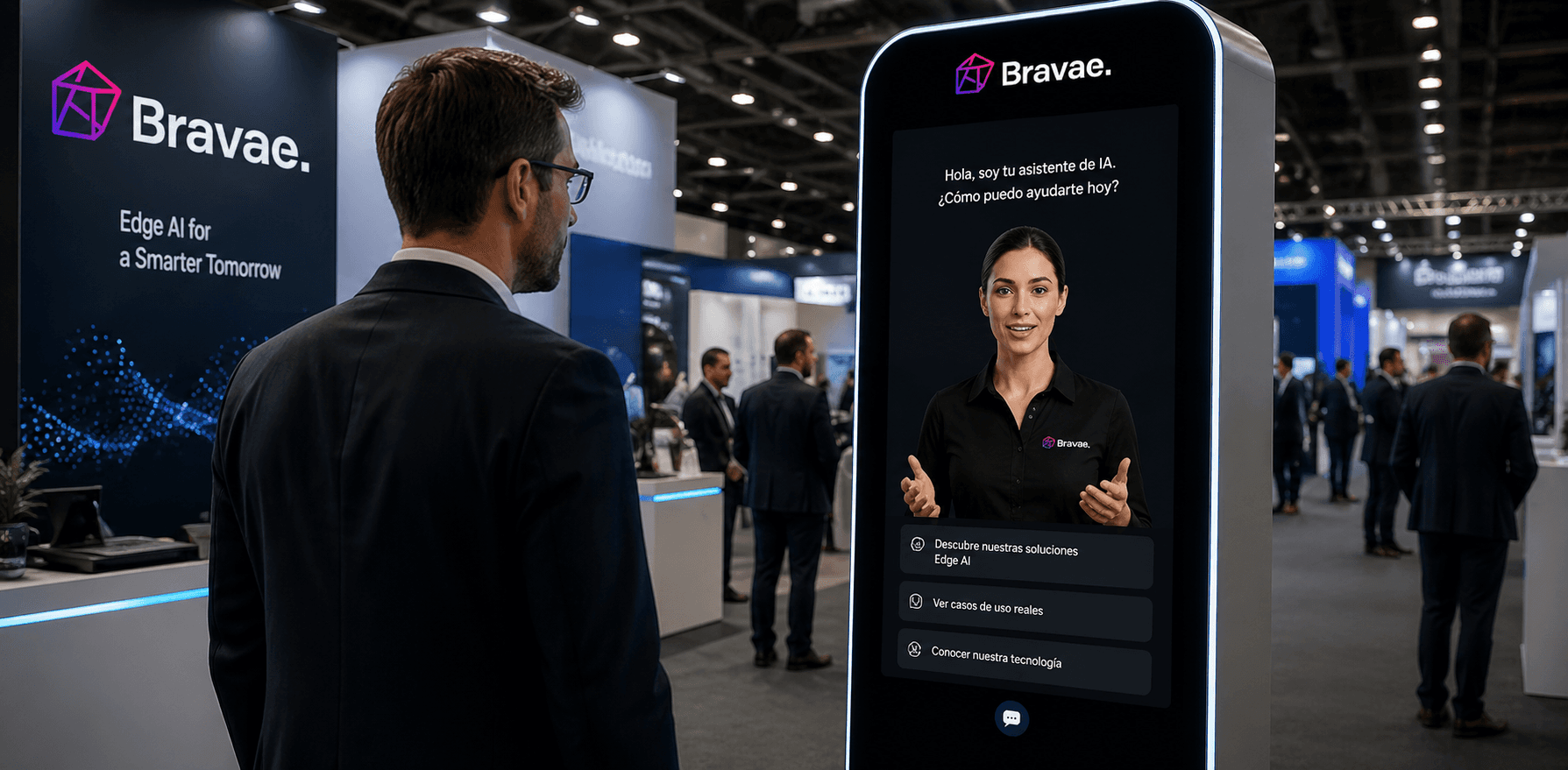
Edge: Robust AI in the real world
When reliability and experience matter more than the model's theoretical power.
Much of generative AI has been developed around the cloud: remote models, APIs, and interaction patterns that tolerate some latency.
That approach works well in many cases.
But not in all.
In real physical environments —industrial, public, commercial— what matters isn't just latency. It's the robustness of the system in real conditions.
When the system cannot fail
An assistant in an industrial plant, a hospital, or a public space operates under different conditions:
- connectivity not always guaranteed,
- continuous interaction,
- non-technical users,
- need for immediate response.
Here, fault tolerance is minimal.
Lightness and control as an advantage
In these scenarios, lighter and more optimized models are not a limitation.
They are an advantage:
- greater stability,
- less external dependency,
- better operational control.
They also allow building more specific systems adapted to the context.
The real foundation: experience
The central element is not technical. It is experiential.
AI in these environments:
- guides,
- responds,
- interacts,
- and is part of the space.
It's not an isolated feature.
It's part of the user experience.
Bravae's approach
Bravae designs these systems as a whole:
- architecture (what runs where),
- reliability,
- latency management,
- interface integration (voice, avatar, visual),
- and long-term maintenance.